
Effect of combination of organosulfur and polyphenols organic fungicide on Ganoderma-infected oil palm seedlings
Article Sidebar
Main Article Content
Abstract
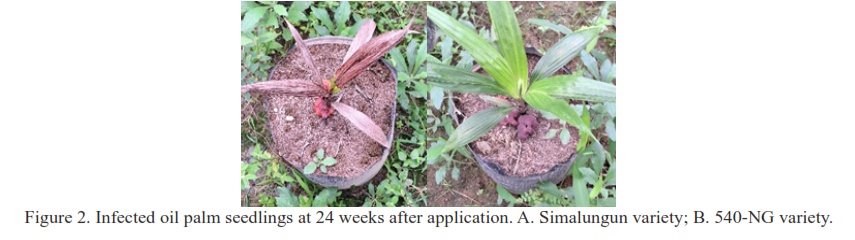
The curative potential of an organic fungicide against Ganoderma boninense was previously assessed in vitro and yielded promising results. This organic fungicide was formulated using a combination of organosulfur compounds and polyphenols (OSC-P) as active ingredients. This study aimed to evaluate the effectiveness of OSC-P application in controlling basal stem rot (BSR) disease in infected oil palm seedlings of different varieties and to determine the optimum application dose. Two oil palm varieties were used: a G. boninense-susceptible variety and a moderately tolerant variety. The seedlings were artificially infected with G. boninense using inoculated rubber wood blocks (RWB). OSC-P was applied to 16-week-old seedlings by soil drenching at a volume of 200 mL per plant at 2-week intervals for 24 weeks. A total of six treatments, including controls, were arranged with four replications and observed at 4-week intervals. Each replication consisted of 10 seedlings. Observed parameters included disease incidence, disease severity, and vegetative growth parameters. The results showed that OSC-P application significantly reduced the incidence and severity of BSR disease in infected oil palm seedlings. BSR symptoms were less severe in the moderately tolerant variety than in the susceptible variety; however, disease incidence did not differ significantly between the two varieties. The optimum application dose of OSC-P was 0.8% (v/v), and variations in application dose did not significantly affect disease incidence or severity at 24 weeks after application. These findings are expected to complement existing preventive strategies for BSR management.
Article Details

This work is licensed under a Creative Commons Attribution-NonCommercial 4.0 International License.
Authors retain copyright of their published articles and grant the journal the right of first publication.
All articles published in Jurnal Hama dan Penyakit Tumbuhan Tropika: Journal of Tropical Plant Pests and Diseases are licensed under the Creative Commons Attribution-NonCommercial 4.0 International (CC BY-NC 4.0) license.
This license permits others to share, copy, distribute, and adapt the published work for non-commercial purposes, provided that appropriate credit is given to the original author(s) and the journal.
References
Aala F, Yusuf UK, Nulit R, & Rezaie S. 2014. Inhibitory effect of allicin and garlic extracts on growth of cultured hyphae. Iran. J. Basic Med. Sci. 17(3): 150–154.
Abdullah F, Ilias GNM, Nelson M, Izzati NAMZ, & Yusuf UK. 2003. Disease assessment and the efficacy of Trichoderma as a biocontrol agent of basal stem rot of oil palms. Sci. Putra (Malaysia). 11(2): 31–33.
Akpo E, Stomph TJ, Kossou DK, Omore AO, & Struik PC. 2014a. Effects of nursery management practices on morphological quality attributes of tree seedlings at planting: The case of oil palm (Elaeis guineensis Jacq.). For. Ecol. Manag. 324: 28–36. https://doi.org/10.1016/J.FORECO.2014.03.045
Akpo E, Stomph TJ, Kossou DK, & Struik PC. 2014b. Growth dynamics of tree nursery seedlings: The case of oil palm. Sci. Hortic. 175: 251–257. https://doi.org/10.1016/j.scienta.2014.06.020
Archer L, Crane JH, & Albrecht U. 2022. Trunk injection as a tool to deliver plant protection materials— An overview of basic principles and practical considerations. Horticulturae. 8(6): 552. https://doi.org/10.3390/horticulturae8060552
Assis K, Chong KP, Idris AS, & Ho CM. 2016. Economic loss due to Ganoderma disease in oil palm. Int. J. Econ. Manag. Eng. 10(2): 631–635. https://doi.org/10.5281/zenodo.1111999
BaQais A, El-Saeid MH, & Alshabanat M. 2024. UV-light-induced photocatalytic degradation of organic pesticides in agricultural soils with Fe2O3 and H2O2. J. Saudi. Chem. Soc. 28(6): 101953. https://doi.org/10.1016/j.jscs.2024.101953
Bhatwalkar SB, Mondal R, Krishna SBN, Adam JK, Govender P, & Anupam R. 2021. Antibacterial properties of organosulfur compounds of garlic (Allium sativum). Front. Microbiol. 12: 613077. https://doi.org/10.3389/fmicb.2021.613077
Bocianowski J, Tratwal A, & Nowosad K. 2020. Genotype by environment interaction for area under the disease-progress curve (AUDPC) value in spring barley using additive main effects and multiplicative interaction model. Australasian Plant Pathol. 49(5): 525–529. https://doi.org/10.1007/s13313-020-00723-7
Borlinghaus J, Albrecht F, Gruhlke MCH, Nwachukwu ID, & Slusarenko AJ. 2014. Allicin: Chemistry and biological properties. Molecules. 19(8): 12591–12618. https://doi.org/10.3390/molecules190812591
Breton F, Hasan Y, Hariadi, Lubis Z, & de Franqueville H. 2006. Characterization of parameters for the development of an early screening test for basal stem rot tolerance in oil palm progenies. J. Oil Palm Res. Special Issue: 24–36. http://palmoilis.mpob.gov.my/publications/jopr2006sp-ms24.pdf
Campbell CL & Madden LV. 1990. Introduction to Plant Disease Epidemiology. John Wiley & Sons. New York. USA.
Chuanjun X, Zhiwei R, Ling L, Biyu Z, Junmei H, Wen H, & Ou H. 2015. The effects of polyphenol oxidase and cycloheximide on the early stage of browning in Phalaenopsis explants. Hortic. Plant. J. 1(3): 172–180. https://doi.org/10.16420/j.issn.2095-9885.2015-0030
Corley RHV & Tinker PBH. 2016. Disease of the Oil Palm. In: The Oil Palm (5th edition). pp. 399-436. Blackwell Science. USA. https://doi.org/10.1002/9781118953297
Daniel CK, Lennox CL, & Vries FA. 2015. In-vitro effects of garlic extracts on pathogenic fungi Botrytis cinerea, Penicillium expansum and Neofabraea alba. S. Afr. J. Sci. 111(7/8): Art. #2014–0240. https://doi.org/10.17159/SAJS.2015/20140240
Decourtye A, Henry M, & Desneux N. 2013. Overhaul pesticide testing on bees. Nature. 497: 188. https://doi.org/10.1038/497188a
Diptaningsari D, Meithasari D, Karyati H, & Wardani N. 2022. Potential use of coconut shell liquid smoke as an insecticide on soybean and the impact on agronomic performance. IOP Conf. Ser. Earth Environ. Sci. 985: 012058. https://doi.org/10.1088/1755-1315/985/1/012058
Ennacerie FZ, Filali FR, Moukrad N, & Bouymajane A. 2019. Polyphenols, antioxidant activity and mode of action of antimicrobial compounds of Dittrichia viscosa extracts. AJMAP. 5(3): 90–106. https://doi.org/10.48347/IMIST.PRSM/AJMAP-V5I3.18669
Flood J, Bridge PD, & Pilotti CA. 2022. Basal stem rot of oil palm revisited. Ann. Appl. Biol. 181(2): 160–181. https://doi.org/10.1111/aab.12772
Hazra DK & Purkait A. 2019. Role of pesticide formulations for sustainable crop protection and environment management: A review. J. Pharmacogn. Phytochem. 8(2): 686–693.
Jazuli NA, Kamu A, Chong KP, Gabda D, Hassan A, Seman IA, & Ho CM. 2022. A review of factors affecting Ganoderma basal stem rot disease progress in oil palm. Plants. 11(19): 2462. https://doi.org/10.3390/plants11192462
Jeger MJ & Viljanen-Rollinson SLH. 2001. The use of the area under the disease-progress curve (AUDPC) to assess quantitative disease resistance in crop cultivars. Theor. Appl. Genet. 102: 32–40. https://doi.org/10.1007/s001220051615
Martin JJJ, Yarra R, Wei L, & Cao H. 2022. Oil palm breeding in the modern era: Challenges and opportunities. Plants. 11(11): 1395. https://doi.org/10.3390/plants11111395
Kok SM, Goh YK, Tung HJ, GoH KJ, Wong WC, & Goh YK. 2013. In vitro growth of Ganoderma boninense isolates on novel palm extract medium and virulence on oil palm (Elaeis guineensis) seedlings. Mal. J. Microbiol. 9(1): 33–42. https://doi.org/10.21161/mjm.45212
Kutawa AB, Danladi MD, & Haruna A. 2018. Antifungal activity of garlic (Allium sativum) extract on some selected fungi. J. Med. Herb. Ethnomed. 4: 12–14. https://doi.org/10.25081/jmhe.2018.v4.3383
Lisnawita, Hanum H, & Tantawi AR. 2016. Survey of basal stem rot disease on oil palms (Elaeis guineensis Jacq.) in Kebun Bukit Kijang, North Sumatera, Indonesia. IOP Conf. Ser.: Earth Environ. Sci. 41: 012007. https://doi.org/10.1088/1755-1315/41/1/012007
Mahmood I, Imadi SR, Shazadi K, Gul A, & Hakeem KR. 2016. Effects of pesticides on environment. In: Hakeem K, Akhtar M, & Abdullah S (Eds.). Plant, Soil and Microbes. Volume 1: Implications in Crop Science. pp. 253–269. Springer, Cham. https://doi.org/10.1007/978-3-319-27455-3_13
Manengkey GSJ & Senewe E. 2011. Intensitas dan laju infeksi penyakit karat daun Uromyces phaseoli pada tanaman kacang merah [Intensity and infection rate of rust leaf Uromyces phaseoli on red bean]. Eugenia. 17(3): 218–223. https://doi.org/10.35791/eug.17.3.2011.3546
Martínez OL, Plata-Rueda A, & Martínez LC. 2013. Oil palm plantations as an agroecosystem: Impact on integrated pest management and pesticide use. Outlooks Pest Manag. 24(5): 225–229. https://doi.org/10.1564/v24_oct_10
Mendoza L, Navarro F, Melo R, Báez F, & Cotoras M. 2019. Characterization of polyphenol profile of extracts obtained from grape pomace and synergistic effect of these extracts and fungicide against Botrytis cinerea. J. Chil. Chem. Soc. 64(4): 4607–4609. https://doi.org/10.4067/S0717-97072019000404607
Mitra S, Saran RK, Srivastava S, & Rensing C. 2024. Pesticides in the environment: Degradation routes, pesticide transformation products and ecotoxicological considerations. Sci. Total Environ. 935: 173026. https://doi.org/10.1016/j.scitotenv.2024.173026
Nagy K, Duca RC, Lovas S, Creta M, Scheepers PTJ, Godderis L, & Ádám B. 2020. Systematic review of comparative studies assessing the toxicity of pesticide active ingredients and their product formulations. Environ. Res. 181: 108926. https://doi.org/10.1016/j.envres.2019.108926
Ngegba PM, Cui G, Khalid MZ, & Zhong G. 2022. Use of botanical pesticides in agriculture as an alternative to synthetic pesticides. Agriculture. 12(5): 600. https://doi.org/10.3390/agriculture12050600
Nur-Rashyeda R, Idris AS, Sundram S, Zainol-Hilmi NH, & Ming SC. 2023. A field evaluation on fungicides application to control upper stem rot (USR) disease in oil palm caused by Ganoderma spp. J. Oil Palm Res. 35(2): 320–329. https://doi.org/10.21894/jopr.2022.0037
Prabowo H, Martono E, & Witjaksono. 2016. Activity of liquid smoke of tobacco stem waste as an insecticide on Spodoptera litura Fabricius larvae. Indones. J. Plant Prot. 20(1): 22–27. https://doi.org/https://doi.org/10.22146/jpti.16620
Priwiratama H, Pradana MG, Susanto A, Rozziansha TAP, & Istiqomah FN. 2022. Dampak aplikasi konsorsium mikoriza terhadap pertumbuhan vegetatif tanaman dan perkembangan penyakit Ganoderma di pembibitan kelapa sawit [Effect of mycorrhizal consortium application on plant growth and the development of Ganoderma disease in oil palm nursery]. J. Pen. Kelapa Sawit. 30(3): 123–140. https://doi.org/10.22302/iopri.jur.jpks.v30i3.190
Priwiratama H, Prasetyo AE, & Susanto A. 2020. Incidence of basal stem rot disease of oil palm in converted planting areas and control treatments. IOP Conf. Ser.: Earth Environ. Sci. 468: 012036. https://doi.org/10.1088/1755-1315/468/1/012036
Priwiratama H & Susanto A. 2020. Kejadian penyakit busuk pangkal batang pada tanaman belum menghasilkan varietas toleran Ganoderma dengan sistem lubang tanam standar [Disease incidence of basal stem rot on immature plant of tolerant variety with standard plant hole system]. WARTA PPKS. 25(3): 115–122. https://doi.org/10.22302/iopri.war.warta.v25i3.20
Rahman KA & Othman R. 2020. Influence of pH levels on disease development in oil palm seedling roots infected with Ganoderma boninensis. Rhizosphere. 13: 100181. https://doi.org/10.1016/j.rhisph.2019.100181
Rakib MRM, Borhan AH, & Jawahir AN. 2019. The relationship between SPAD chlorophyll and disease severity index in Ganoderma-infected oil palm seedlings. J. Bangladesh Agric. Univ. 17(3): 355–358. https://doi.org/10.3329/jbau.v17i3.43211
Rees RW, Flood J, Hasan Y, Potter U, & Cooper RM. 2009. Basal stem rot of oil palm (Elaeis guineensis); mode of root infection and lower stem invasion by Ganoderma boninense. Plant Pathol. 58(5): 982–989. https://doi.org/10.1111/j.1365-3059.2009.02100.x
Rini MV, Hasan SN, Hidayat KF, & Aeny TN. 2022. Applications of arbuscular mycorrhiza fungi to improve growth of oil palm seedlings and disease resistance against Ganoderma sp. J. Appl. Agricultural Sci. Technol. 6(1): 31–40. https://doi.org/10.55043/jaast.v6i1.40
Sarfraz M, Nasim MJ, Jacob C, & Gruhlke MCH. 2020. Efficacy of allicin against plant pathogenic fungi and unveiling the underlying mode of action employing yeast based chemogenetic profiling approach. App. Sci. 10(7): 2563. https://doi.org/10.3390/app10072563
Sharma S, Rashmi D, & Patel SI. 2023. Stem rust severity and AUDPC values of different wheat varieties in response to Puccinia graminis f. sp tritici. Crop Res. 58(3–4): 189–193. https://doi.org/10.31830/2454-1761.2023.CR-904
Shaw MW, Emmanuel CJ, Emilda D, Terhem RB, Shafia A, Tsamaidi D, Emblow M, & van Kan JAL. 2016. Analysis of cryptic, systemic Botrytis infections in symptomless hosts. Front. Plant Sci. 7: 187522. https://doi.org/10.3389/fpls.2016.00625
Simko I & Piepho HP. 2012. The area under the disease progress stairs: Calculation, advantage, and application. Phytopathology. 102(4): 381–389. https://doi.org/10.1094/PHYTO-07-11-0216
Smith CJ & Perfetti TA. 2020. A comparison of the persistence, toxicity, and exposure to high-volume natural plant-derived and synthetic pesticides. Toxicol. Res. App. 4: 1–15. https://doi.org/10.1177/2397847320940561
Stergiopoulos I & Gordon TR. 2014. Cryptic fungal infections: The hidden agenda of plant pathogens. Front. Plant Sci. 5: 506. https://doi.org/10.3389/fpls.2014.00506
Sulaiman SKB, Ibrahim Y, & Jeffree MS. 2019. Evaluating the perception of farmers towards pesticides and the health effect of pesticides: A cross-sectional study in the oil palm plantations of Papar, Malaysia. Interdiscip. Toxicol. 12(1): 15–25. https://doi.org/10.2478/intox-2019-0003
Supramani S, Rejab NA, Ilham Z, Wan-Mohtar WAAQI, & Ghosh S. 2022. Basal stem rot of oil palm incited by Ganoderma species: A review. Eur. J. Plant Pathol. 164(1): 1–20. https://doi.org/10.1007/s10658-022-02546-2
Townsend GR & Heubergeb JW. 1943. Methods for estimating losses caused by diseases in fungicide experiments. Plant Dis. Rep. 27(17): 340–343. https://www.cabidigitallibrary.org/doi/full/10.5555/19451100061
Tudi M, Ruan HD, Wang L, Lyu J, Sadler R, Connell D, Chu C, & Phung DT. 2021. Agriculture development, pesticide application and its impact on the environment. Int. J. Environ. Res. Public Health. 18(3): 1112. https://doi.org/10.3390/ijerph18031112
Wallock-Richards D, Doherty CJ, Doherty L, Clarke DJ, Place M, Govan JRW, & Campopiano DJ. 2014. Garlic revisited: antimicrobial activity of allicin-containing garlic extracts against Burkholderia cepacia Complex. PLOS ONE. 9(12): e112726. https://doi.org/10.1371/journal.pone.0112726
Yusup CA, Eris DD, Pradana MG, Mulyatni AS, & Widiastuti H. 2023. Fractional inhibitory concentration index of the allicin and flavonoids combinations against Ganoderma boninense. IOP Conf. Ser. Earth Environ. Sci. 1255: 012061. https://doi.org/10.1088/1755-1315/1255/1/012061
Yusup CA, Eris DD, Mulyatni AS, Pradana MG, & Widiastuti H. 2024a. In vitro antifungal activity of several organic compounds against Ganoderma boninense. IOP Conf. Ser. Earth Environ. Sci. 1308: 012003. https://doi.org/10.1088/1755-1315/1308/1/012003
Yusup CA, Eris DD, Mulyatni AS, Pradana MG, Widiastuti H, & Santoso D. 2024b. Potensi kombinasi ekstrak bawang putih dan polifenol sebagai metode kuratif pengendalian Ganoderma boninense [Potential of combination of garlic extract and polyphenols as a curative method for controlling Ganoderma boninense]. J. Pen. Kelapa Sawit. 32(2): 111–128. https://doi.org/10.22302/iopri.jur.jpks.v32i2.259